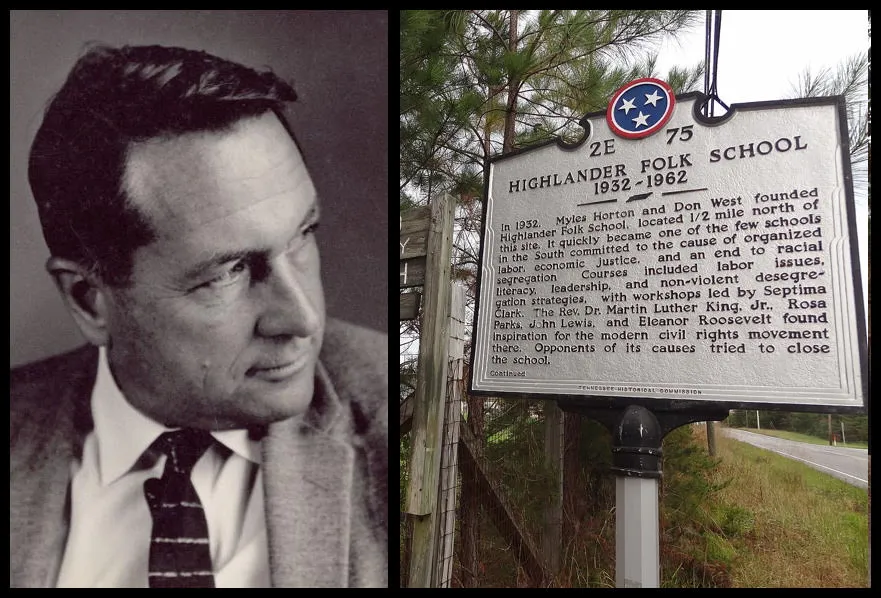
The famed educator and Highlander Folk School founder offers insights on living through the ups and downs of movement cycles.
Published in Waging Nonviolence and Convergence.
Over a career that spanned more than 50 years and touched on some of the major American social movements of the 20th century, Myles Horton established himself as one of our country’s most renowned popular educators.
Horton was a key founder of the Highlander Folk School, later reformed as the Highlander Research and Education Center after it was shut down by Jim Crow officials in Tennessee in 1961. The adult education program maintained deep ties to working people in the South and played an important role in the labor upheavals of the New Deal era in the 1930s. Furthermore, by the 1940s, it had emerged as one of the few integrated institutions in the region, a place where white activists and people of color could learn and strategize together for their common liberation.
Rosa Parks famously attended Highlander before returning home and declining to give up her seat on a segregated bus. Among the other prominent names in the civil rights movement who walked its grounds were Martin Luther King Jr., Ella Baker, Septima Poinsette Clark, Andrew Young, John Lewis and Dorothy Cotton. But Highlander’s impact is properly measured less by the luminaries it influenced than by the countless unheralded union shop stewards and local community leaders who were enriched by coming together to study and struggle with others who faced similar challenges in their lives, and who left inspired to make greater contributions to creating change.
Sometimes referred to as a “hillbilly radical” or “hillbilly intellectual,” Horton is best known as a pioneer of progressive pedagogy. But as someone who spent his life navigating the ups and downs of social movements, he also developed important insights into the cycles of mass mobilization and patient preparation that often characterize organizing life. Horton at once built a lasting movement institution and grew skeptical of organizations that became overly bureaucratic and outlived their usefulness. Understanding how he balanced these tensions, and how he believed organizers could effectively intervene at different moments in a movement’s life cycle, remains valuable for those continuing the fight for social justice today.
* * * * *
A people’s pedagogy
Myles Horton was born in 1905 in Savannah, Tennessee. His grandfather was illiterate but had a keen mind and a healthy disrespect for the habits of the area’s wealthy powerbrokers. Raised by schoolteacher parents, Horton grew up in a religious atmosphere of hard work and devotion. At age 15, he left home and supported himself by working to build crates in a tomato packing plant and taking on other odd jobs.
Always working in and among communities of people in Appalachia, he knew early on that education was a calling, and in 1924 he entered Cumberland University to pursue a degree, while continuing to spend his summers teaching Presbyterian Bible classes in the Tennessee mountains. Around 1929, Horton managed to get a spot at the Union Theological Seminary in New York City, a place that he would later claim greatly enlarged his perspective. Horton jokes that he was accepted not because he was academically prepared but as a kind of “token hillbilly” — one of the few students from the rural South. At Union he studied with renowned socialist and pacifist theologian Reinhold Niebuhr, with whom he began to wrestle with ideas of the social gospel, a Protestant movement that used Christian ideals to argue for a committed progressive assault on poverty and other social problems.
Over time, Horton became more secular in his worldview, but these early lessons would remain. He would come to agree with Che Guevara’s famous statement: “Let me say, with the risk of appearing ridiculous, that the true revolutionary is guided by strong feelings of love.” But for Horton, this idea was an outgrowth of his religious roots: “Love people, that’s right out of the Bible,” he explained. “You can’t be a revolutionary, you can’t want to change society if you don’t love people, there’s no point in it.”
Horton continued his education at the University of Chicago, where he studied with sociologist Robert E. Park and developed his earliest notions of forming a school. His greater influence, however, came from visiting Denmark in 1931, where he studied the country’s folk school movement. Launched in the mid-19th century by poet, philosopher and pastor N. F. S. Grundtvig, the Danish folk schools emphasized communal, experiential learning which integrated music and folk knowledge. On his last night in Denmark, Horton wrote: “I can’t sleep, but there are dreams. … You can go to school all your life, you’ll never figure it out because you are trying to get an answer that can only come from the people in the life situation.”
He left Denmark determined to start a similar school in the Southern Highlands of the United States, and he jotted a list of lessons he would bring with him:
“Students and teachers living together
Peer learning
Group singing
Freedom from state regulation
Nonvocational education
Freedom from examinations
Social interaction in nonformal setting
A highly motivating purpose
Clarity in what for and what against.”
When Highlander was founded in 1932, it would be for the training of “effective labor leadership and action” and for using “education as one of the instruments for bringing about a new social order.” This mission would soon bear fruit with the explosion of the Congress of Industrial Organizations, or CIO, after 1935. Working with these unions, Highlander spearheaded a program for preparing shop stewards and labor educators. “Within two years Highlander became the official CIO educational training center for the entire south,” Horton wrote. In 1937, Horton himself helped to organize one of the first CIO locals of textile industry workers, including white and Black workers alike, in the region.
In the 1950s, after the labor insurgency lost steam, Highlander became a key support system and training ground for the growing civil rights movement. Horton worked with local activists in South Carolina to develop programs that could prepare African Americans to pass literacy tests and vote. They then brought the lessons back to Highlander and, under the leadership of Septima Poinsette Clark and Bernice Robinson, developed them into a program for spreading Citizenship Schools across the South. These initiatives became a major mechanism for recruitment and personal development in the burgeoning movement, creating a base of volunteers for activist campaigns. Highlander also played a pivotal role in the formation of the Student Nonviolent Coordinating Committee, or SNCC, having served as the location of early meetings for student leaders who organized sit-ins at segregated lunch counters. Moreover, singers at Highlander were instrumental in adapting and popularizing “We Shall Overcome,” which became a central movement anthem.
Officially, Horton retired in the early 1970s, handing off the management of Highlander to younger colleagues. Yet he remained an active participant in the center’s programs, and he was an important voice in international discussions about popular education until his death in 1990.
* * * * *
Living through movement cycles
Many social movement theorists and practitioners — Sidney Tarrow and Bill Moyer notable among them — have written on how movements progress through up-and-down cycles. What is distinctive about Myles Horton is how he lived through several major movement cycles during his long career, worked to adapt Highlander’s role amidst them and later reflected thoughtfully on his experience.
“Highlander’s always been in the mountainous part of the United States,” the educator once stated, “and our history at Highlander has been an up and down history, peaks and valleys and hills and hollers.” Horton believed that the course of social movements mirrored this hilly topography. And he used the metaphor of peaks and valleys to describe these different movement periods.
At the peak were what Horton called “movement times,” or periods of intensive social movement mobilization. He contrasted these with the valleys in between, slower and less dynamic times which he called “organizational periods.” Knowing which type of time period they are living through helps social movement participants determine what avenues for productive activity are open to them.
Horton wrote, “The best educational work at Highlander has always taken place when there is social movement. We’ve guessed right on two social movements — the labor movement in the 1930s and 1940s, and the civil rights movement in the 1950s and 1960s. During movement times, the people involved have the same problems and can go from one community to the next, start a conversation in one place and finish it in another.”
These periods do not last forever, though. After the disbanding of the 1968 Poor People’s Campaign, which amassed in Washington, D.C. for several months in the wake of Martin Luther King Jr.’s assassination, Horton saw Highlander as primarily working in valleys. He wrote in the late 1980s about how this was distinct from a movement peak: “Now we’re in what I call an organizational period, which has limited objectives, doesn’t spread very rapidly and has a lot of paid people and bureaucracy. It’s completely different from what takes place when there is a social movement.”
Horton did not believe you could do much to spark a new movement upsurge. But you could try to prepare for them. “During organization times you try to anticipate a social movement, and if it turns out that you’ve guessed right, then you’ll be on the inside of a movement helping with the mobilization and strategies, instead of on the outside jumping on the bandwagon and never being an important part of it,” he argued. The essence of this work is preparing “the groundwork for a larger movement. That way, you’re built into it when the momentum begins.”
Although he did not elaborate extensively on his vision for the “spadework” — as Ella Baker called it — necessary in organizational periods, he suggested that these slower times were critical for developing the consciousness and capabilities of movement participants. “The valley periods can be used just to kill time and survive, or they can be used to lay the groundwork of being inside when a movement occurs,” he said. “That’s what makes it possible for us to have peak periods.”
* * * * *
The unique properties of peak mobilizations
For those of us who study movement cycles, and particularly those who have worked to map dynamics of peak mobilizations, a number of interesting observations by Horton stand out.
Periods of intensive movement activity — what my brother Paul and I describe in our book “This Is an Uprising” as “moments of the whirlwind” — are often unpredictable and generally poorly understood. Many people tend to downplay their significance, including political observers outside of movements, who regard outbreaks of mass protest as fluke occurrences. But it includes many organizers as well, who see whirlwinds as unreliable and therefore unimportant.
Myles Horton did not downplay peak periods. Instead, he highlighted a variety of their distinctive characteristics.
First, he identified how mass mobilizations promote autonomous action among movement participants and members of the public. Horton saw movement times as unique periods in which ideas spread quickly and participation expands rapidly. He wrote, “It’s only in a movement that an idea is often made simple enough and direct enough that it can spread rapidly. Then your leadership multiplies very rapidly, because there’s something explosive going on.”
Horton told the story of an older community member in a Southern town who told him about creating her own Citizenship School, teaching people to read as a means of preparing them to vote and increasing their political engagement. She was not aware that an extensive network of such schools had been developed by movement groups including Highlander and the Southern Christian Leadership Conference, or SCLC. Horton speculated that “She’d probably been to a conference where somebody was talking about Citizenship Schools,” and the concept was intuitive enough that “she could pick it up and make it her own.” Far from being an isolated example, it is common in mass mobilizations that tactical repertoires disseminate rapidly and are reproduced organically.
Acts of courage become contagious. “People see that other people not so different from themselves do things that they thought could never be done,” Horton explained. “They’re emboldened and challenged by that to step into the water, and once they get in the water, it’s as if they’ve never not been there.”
Second, Horton notes that, by their nature, movements are polarizing. They elicit mass participation not by creating great unity in society, but rather by highlighting controversies potent enough that people are motivated to throw down. “A large social movement forces people to take a stand for or against it, so that there are no longer any neutrals,” he wrote. “You’ve got to be on one side or the other.”
While polarization can provide powerful benefits to movements, it also has downsides. “It’s true that it forces some people to be worse than they would be, more violent than they would be,” Horton noted, “but it also forces some people to get behind the cause and work for it and even die for it.”
We have argued elsewhere that this balance of polarization’s positive and negative potentials must be carefully managed. That said, the conflictual nature of movement challenges is not an unfortunate development that can be avoided through better social dialogue. Instead, it is an inherent part of the process of change. As Frederick Douglass stated long ago, “If there is no struggle, there is no progress. Those who profess to favor freedom and yet deprecate agitation are men who want crops without plowing the ground.”
Horton echoed this sentiment, writing: “People have to understand that you can’t make progress without pain, because you can’t make progress without provoking violent opposition. If enough people want change and others stand in their way, they’re going to force them out of the way.”
Third, Horton observed that movement surges rely on a type of momentum that is not generated by ordinary organizational activity. During organizational periods, “which is most of the time,” he stated, groups will work to achieve limited short-term goals. But this does not propel significant participation by the general public, even if many groups are working toward common aims. Organization, in this way, does not make a movement moment. But once a whirlwind period starts, members of existing groups respond to the polarizing call of mass mobilizations, and the leaders of these groups can choose to feed into the energy.
Horton wrote that: “During the civil rights movement, for instance, people came out of the labor movement, the Black churches, the pacifist movement; people came who wanted social equality, and once the movement got under way, people who wanted to be where the excitement was were in it, people who wanted to get rid of their guilt were in it — it was so big that there was room for everybody.”
Among mass protest trainers we work with in the U.S., there is a saying that: “Alignment does not create momentum. Momentum creates alignment.” As much as we might like it to be, putting together a perfect coalition of groups that agree on a common set of demands is not a recipe for revolt. Instead, it tends to produce a lowest-common-denominator form of unity. On the other hand, a movement in motion has a way of joining a wide range of forces in pursuit of a common vision, often one more ambitious than many would have selected themselves.
* * * * *
The problem of bureaucracy
In Highlander, Horton helped establish an organization that has endured for generations. He titled his memoir “The Long Haul,” upholding the value of persistent struggle. And yet he also voiced a critique of the bureaucratizing tendencies of institutions — even progressive ones. This combination made him a very interesting observer of organizational life.
Because their prescriptions fly in the face of much common organizing practice, some of the leading theorists of disruptive mobilization, such as Frances Fox Piven and Richard Cloward, have been accused of being “anti-organization” or of skewing anarchistic in their analysis of the role of institutions in creating progressive change. Horton recognized the importance of organizations. Without them, people acting merely as individuals would be limited in their effectiveness. At the same time, he was skeptical of how institutions had a tendency to ossify and lose their vitality over time.
In “The Long Haul” Horton wrote, “I came to realize that things had to be done through organizations. I knew that people as individuals would remain powerless, but if they could get together in organizations, they could have power, provided they used their organizations instead of being used by them.” He added, “I once wrote something about organizations, saying that they end up in structures and structures become permanent and most of them outlive their usefulness.”
Having witnessed the labor movement go from a disempowered low in the early 1930s to becoming part of the American Cold War political establishment by the end of the 1950s, Horton developed a critique shared by much of the New Left, which looked skeptically on the new power brokers: “I came to the conclusion that the bureaucratic system is an inevitable disease that afflicts all organizations and governments,” he wrote. “Often it is spread by good people who are made to do bad things — or less than good things — because of their separation from the people who were the original source of their power.”
Wary of such bureaucratic institutionalization, Highlander remained an outsider group. Horton contended that “Highlander’s chief interest is in starting up programs.” The school looked to intervene in drives for change by finding needs that others were not meeting and remaining experimental. “We avoided implementing programs that other less cutting-edge organizations or institutions were doing,” Horton wrote, “[and] tried to find ways of working that did not duplicate what was already being done. To be true to our vision, it was necessary to stay small and not get involved in mass education or in activities that required large amounts of money (which would make it tempting to do the kinds of programs that money was available for).”
Horton considered Highlander to be an incubator of new social movement projects, which he was willing to spin off and pass on to others once they were established. When the center’s interventions were developed enough to scale, they would hand them off to other institutions. “We solved the problem of staying small by spinning off programs that were already established and were willingly taken over by organizations less interested in creating new programs,” he explained.
Highlander carried out this process in the 1940s by allowing the CIO to take over its programs for training labor education directors and shop stewards. Later, in the 1960s, it handed off its program to create Citizenship Schools to the SCLC. “The Citizenship School project eventually became too big for us; in fact, it became bigger than all the rest of Highlander put together,” Horton argued. “When it gets to that stage, other people can take it over and operate it.”
“These spin-offs enabled Highlander to concentrate on cutting-edge programs that no one else in the region was undertaking,” he later added.
* * * * *
“One battle, many fronts”
The lens of social movement ecology helps us to understand how Horton settled into a particular niche within progressive movements in the 20th century. This framework contends that distinct organizing approaches and theories of change can each play valuable roles in movement drives. Mass protest, structure-based organizing, inside-game politics, alternative institutions, and programs of personal transformation all make important contributions — although their relative importance can rise or fall at different moments in the cycle of change.
Viewed through this lens, it becomes clear that Horton primarily operated from the place of building an alternative institution and promoting education as a means of personal transformation. While he supported mass protest and structure building, he saw his main role as something different, and he tended to avoid insider politics altogether.
Late in his life, Horton undertook a series of fascinating dialogues with Brazilian educator Paulo Freire, whose book “Pedagogy of the Oppressed” and other writings have become cornerstone texts for many progressive teachers. Their discussions revealed some interesting differences between the two thinkers. Two prominent differences relate to how Horton situated himself within the movement ecosystem.
Freire had at times been appointed to important educational roles in different levels of Brazilian government. He explained that he favored taking on the system from “two fronts,” developing independent projects from the outside while also burrowing into state institutions. This process might be described today as “contentious co-governance,” and it has been pursued by Brazil’s Landless Workers’ Movement, as it has worked to get its ambitious programs of rural, adult education adopted as state-sanctioned programs.
Horton, on the other hand, believed in operating as an outsider. He eschewed the mechanisms of the state and expressed wariness of unions, nonprofits or membership organizations if they grew too bureaucratic or professionalized. This pushed him away from inside-game interventions or structure building, and it kept him primarily rooted in alternatives.
Another difference is that Horton insisted on a difference between education and organizing. The purpose of education, he believed, was to develop people as independent thinkers, able to analyze society and make decisions for themselves about how to change it. Organizing, in contrast, is about bringing people together around a specific goal. “[E]ducation makes possible organization, but there is a different interest, different emphasis,” Horton stated. In contrast, Freire saw education as “a permanent process” that takes place prior to organizing but also afterwards. “[U]ndoubtedly there is a different kind of education in mobilization before taking power, and there is also the continuity of that,” even after movements make gains, he believed.
Once again, Horton’s stance reinforced the idea that his contribution to social movements might be complementary to structure-based organizing, but would remain distinct from it.
In his important 1984 study, “The Origins of the Civil Rights Movement,” sociologist Aldon Morris characterized Highlander as a “movement halfway house,” or “an established group or organization that is only partially integrated into the larger society because its participants are actively involved in efforts to bring about a desired change in society.”
“What is distinctive about movement halfway houses is their relative isolation from the larger society and the absence of a mass base,” Morris wrote. This isolation means that halfway houses, by themselves, can not effectively leverage change or garner widespread support in the public. But, as alternative spaces, they can cultivate a variety of resources that become very valuable to movements. Among these, Morris lists “skilled activists, tactical knowledge, media contacts, workshops, knowledge of past movements, and a vision of a future society.”
Serving as a halfway house, Highlander did not seek to directly intervene to reform dominant bodies in the way that a political campaign or a protest movement making demands on specific politicians or business leaders might. But, like other alternative institutions, the school modeled alternate ways of being in the world. And it increased the capacity of groups in other segments of the ecology to function effectively. As Horton explained: “I’ve always taken the position that Highlander was not in the business of organizing, or even of training organizers, but in education for action, and in helping to develop social leadership.”
A slogan that Horton adopted from a well-known folksinger might be seen as his articulation of a movement ecology perspective: “A few years ago the singer and activist ‘Utah’ Phillips gave me a little pin that says, ‘One Battle, Many Fronts,’” Horton wrote. “The one battle is to rebuild this country, but there are many fronts for dealing with revolutionary change.”
Ultimately, Highlander became an influential institution during Horton’s lifetime, and it continues to do valuable training and support for movements, particularly in the South. But it did not scale in the way he had initially envisioned: “When we established Highlander, [co-founder] Don West and I were sure there would be Highlanders in every state. A dozen or more attempts to start Highlanders were made in this country, but none succeeded.”
In spite of this, Horton’s work offers a compelling model of how popular education can contribute to progressive change, fostering critical thinking in slow times and accelerating the spread of radical ideas during movement peaks. “The nature of my visions are to keep on growing beyond my conception,” he explained near the end of his autobiography. “I think there always needs to be a struggle … because there ought to be growth. You die when you stop growing.”
__________
Research assistance provided by Celeste Pepitone-Nahas. Photo credit: Wikimedia Commons/Bryan MacKinnon

